A Context to Connect with Families
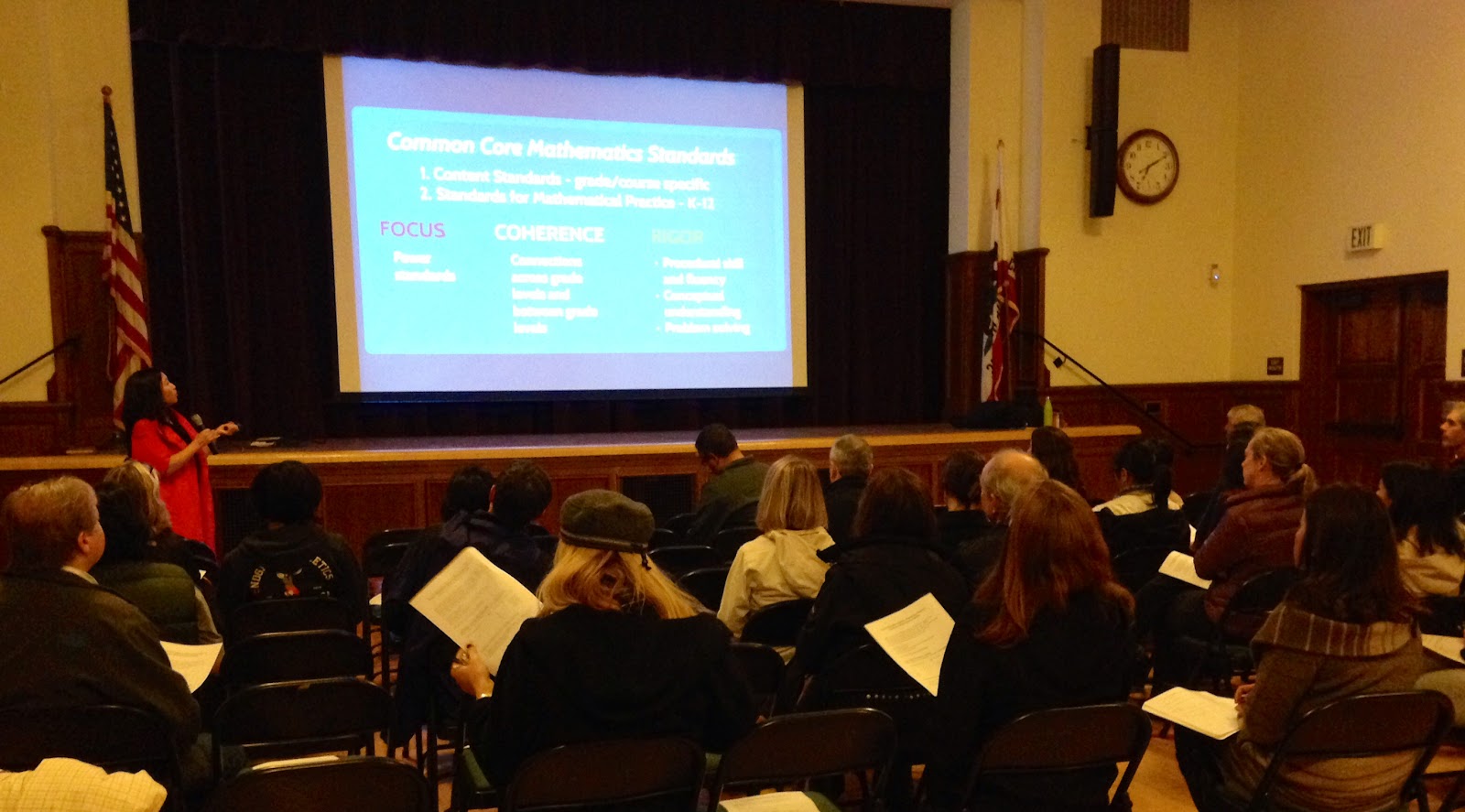
In the last 3 weeks Core Learning has had the opportunity to support math instruction through Parent Math community engagement events in several Alameda County districts. Two of our Parent Math nights coincided with American Education Week and certainly facilitated communication between schools and the public in order to ensure that the successes and needs of schools are celebrated and met, respectively. Beyond AEW, the need for clear and regular communication with families around the Common Core math standards has become increasingly evident as parents and districts begin to experience the implications of the transition to the new standards.
One of the most frequently asked questions that we have heard from parents, whether they have children in the elementary or secondary levels, is why are we teaching math to students in this new, seemingly inefficient way? As parents encounter ways to “do” math that diverges from their own math learning experiences, they may be discovering that their own mathematical understandings are being challenged as they try to support their children’s mathematical development.
As is often the case with new things that we don’t fully understand, it may be tempting to dismiss the different ways that math is being taught. Adjectives we have heard in reference to the Common Core standards include “confusing,” “dumbed-down,” “inefficient,” and “impractical.” However, we have found that as parents engage in the new mathematical models that elementary students are using to understand the why of mathematics, and as they encounter the limitations of their secondary students’ math abilities with the entry of problems that require flexibility of mind and strong problem-solving skills, there is a realization that teaching students procedures and rules without fostering a deep understanding of the structures and systems which these algorithms help to navigate is actually not preparing our students to be critical problem solvers.
Pictorial Models to Develop Conceptual Understanding
At the elementary math nights, the main part of the program focused on having parents and guardians work through common pictorial models being used at the K-5 levels. Participants rotated through stations dedicated to solving math problems through tape diagrams, array and area models, number bonds and ten-frames, and manipulatives to understand place value. The experience is intended to clarify for parents how these models support student understanding of various math concepts. As often happens when students encounter these models for the first time, light bulbs started to go off for adults when they started to recognize how their own mathematical understanding may or may not be based in a strong conceptual foundation.
One example of this is when parents were asked to use a tape diagram to help them understand how to solve the following 1st grade math problem from EngageNY:
Lucy has 5 pencils. Kim has 7 pencils. How many more pencils does Kim have than Lucy?
Over the course of the evening, parents quickly subtracted to find the answer. When asked how they knew to subtract, many of them struggled with a response. When it comes to elementary problems such as this, it is easy for us as adults to forget how we develop the ability to decode stories such as this into arithmetic problems. This is where models such as tape diagrams are useful in providing a visual reference for students as they develop skills to determine the best, most efficient approach to solve problems.
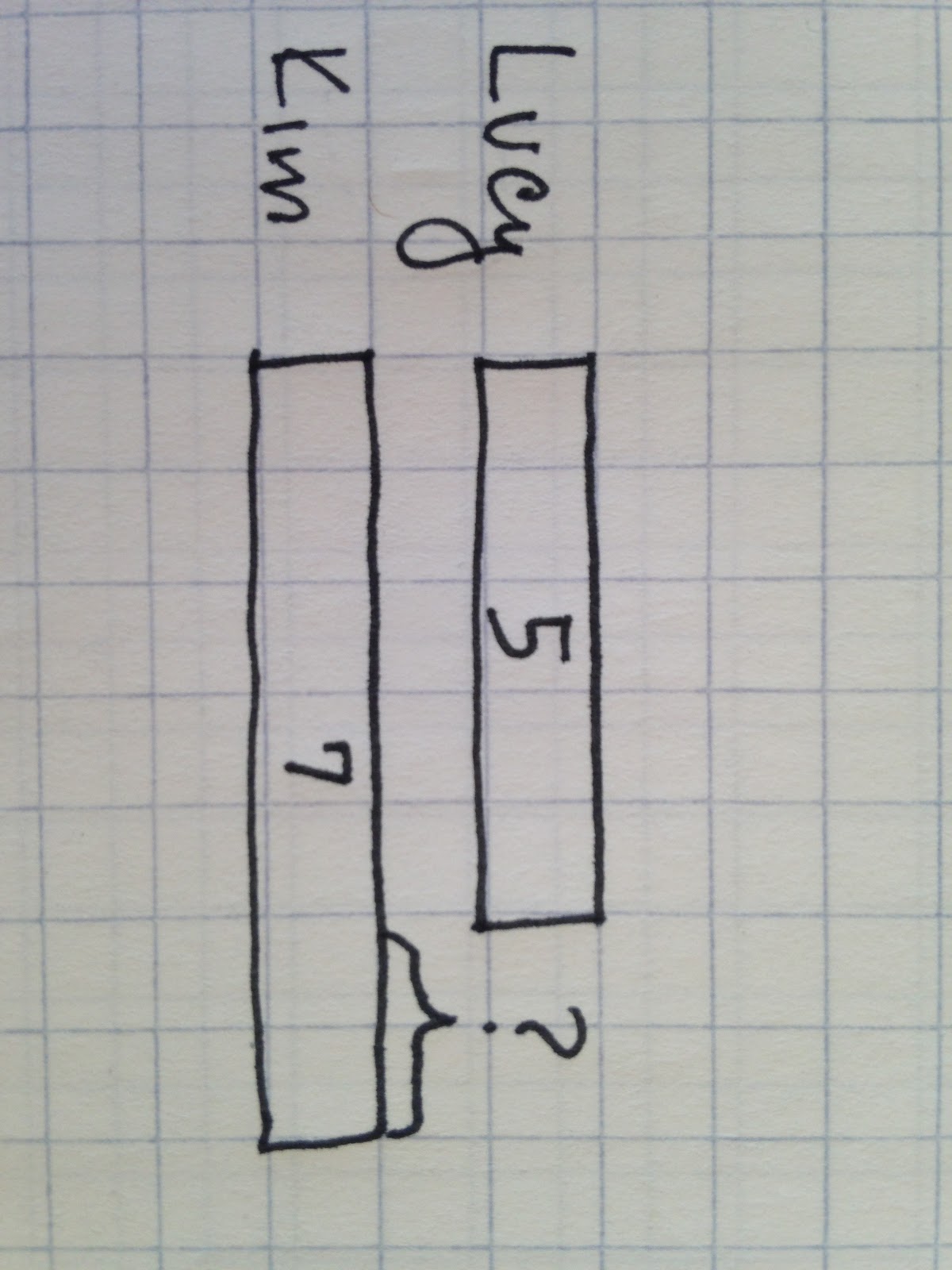
By providing a means for students to see a physical representation of the abstract problem, models such as these provide a scaffold for students as they transition between the concrete and abstract. Further, the integration of mathematical models incorporates at least 2 of the Mathematical Practice standards, furthering our young people’s development of critical and problem-solving skills: 4) Model[ing] with mathematics and 7) Look[ing] for and mak[ing] use of structure. Exposing parents to these modeling approaches, and providing them the experience and language to discuss these mathematical explorations with their children, is just one way that we can support students and their families in building mathematical understanding.
Collaboration to Build Mathematical Meaning and Understanding
At the secondary level, we have seen shifts in instruction towards more student-centered lessons, which often include moves towards increased collaborative learning. In order for students to be productively engaged with classmates, these transitions require problems which are usually open-ended, with multiple solutions and/or means of arriving at the solutions. These 2 basic shifts in content and student interactions require and develop another two of the 8 Mathematical Practices: 3) Construct a viable argument and critique the reasoning of others and 1) Make sense of problems and persevere in solving them.
Given how many of us learned mathematics (taking notes on examples provided by a teacher and then given a handful of problems that allowed us to implement that day’s learning or formula), the groupwork approach to learning and doing mathematics may seem strange. In an era where information and colleagues are at our fingertips, it is essential that we develop students’ abilities to think outside of the proverbial box in conjunction with others. Today’s business leaders are asking for nothing less.
And for those who worry that having students work collaboratively on mathematics reduces their access to rigorous content and skills, here is a great video (with links to others) that demonstrates the high quality of mathematical learning and understanding that can happen. Productive math conversations certainly do not happen by accident, and require ample preparation, but the rewards in terms of student learning are well worth the effort.
Moving Forward
Keeping families in the loop and involved in students’ education should not be limited to single events or to those occasions when major changes are happening in the education landscape. In order to continue the conversation, we encourage districts to continue communicating via language-accessible Parent Engagement nights and newsletters. Additional resources to provide context and language for parents seeking to communicate with their children and schools around math instruction include:
- GreatKids Milestones: videos of students demonstrating grade-level standards (only K-5 currently, with 6-12 coming soon)
- Parent Roadmaps to CCSS-Mathematics: brochures listing standards for each grade-level plus 3-year snapshots to show progression of standards (currently K-8, English and Spanish)
- PTA CCSS Guide to CCSS: Four-page overviews (English and Spanish) of grade-level standards in ELA and Mathematics (K-High School)
Keep the conversations happening, and let us know how they go!
by Celine Liu, Math Specialist


